

Accessible Telehealth for Deaf and Hard of Hearing Patients
Led design of interpreter and live captioning support, enabling deaf and hard of hearing patients to access telehealth for the first time.


The Problem
A hard of hearing patient joined a therapy appointment without captions and couldn’t follow the conversation.
A routine visit turned into a barrier to care, exposing a critical accessibility gap.

Research
Conducted research to understand barriers faced by deaf and hard of hearing patients when booking telehealth appointments.
Key Finding: Patients were often unsure whether telehealth platforms supported accessibility features, creating anxiety when booking care.
Design Goal: Surface accessibility options early so patients can book with confidence.
Key Design Challenges
Designing Accessibility for Complex Scheduling Flows
Challenge
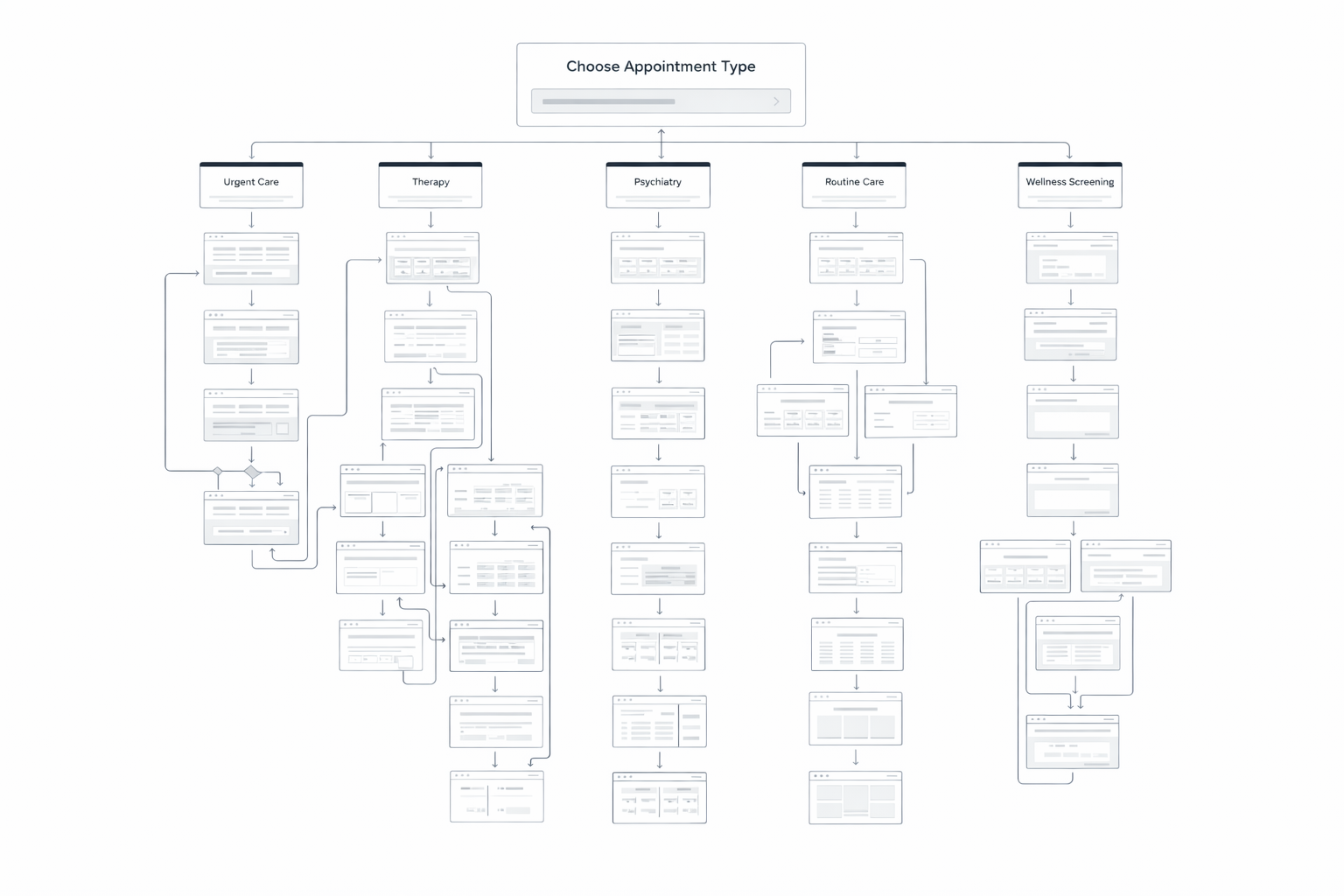
MDLive had multiple appointment types with different scheduling flows.
The challenge was determining where accessibility options could work consistently across them all.
Solution
I explored several placement options, including the appointment type screen.
Ultimately, I introduced language support on the Confirm Patient screen—the first step shared across every scheduling flow—creating a consistent entry point while surfacing support earlier.
Balancing Patient Access with Operational Costs

Challenge
Interpreter services carried significant operational costs, so language support needed to be easy to find without encouraging unnecessary requests.
Solution
Designed a simple language support toggle so patients could request interpreters or captions when needed.
Usability Testing
Tested the scheduling flow with 30 participants to evaluate discoverability.
Result: 100% of participants found the language support toggle.
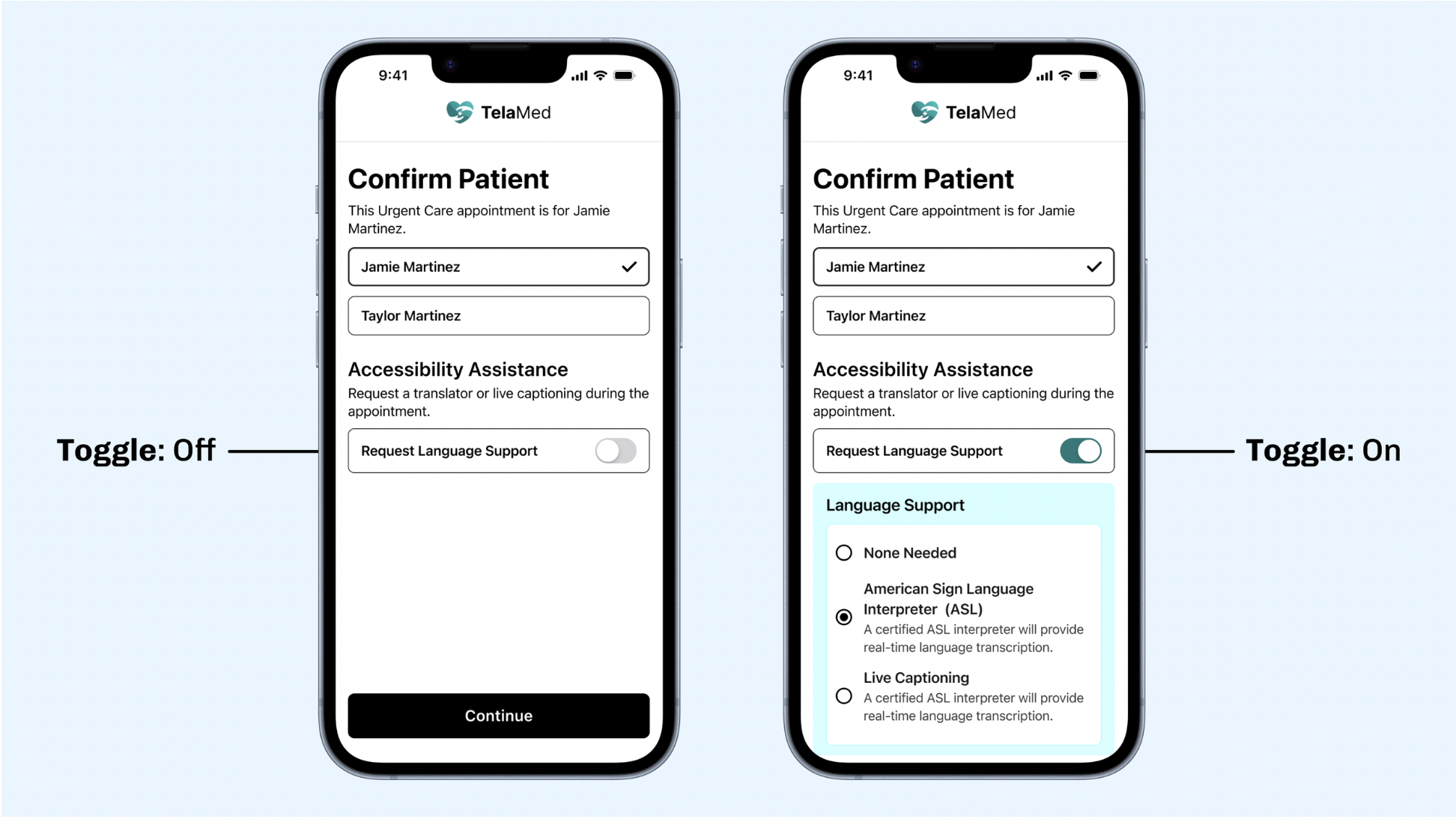
Challenge: Interpreter services carried significant operational costs, so language support needed to be easy to find without encouraging unnecessary requests.
Solution: Designed a simple language support toggle so patients could request interpreters or captions when needed.
Usability Testing
Tested the scheduling flow with 30 participants to evaluate discoverability.
Result: 100% of participants found the language support toggle
Handling the 48-Hour Interpreter Constraint
MDLive is primarily an on-demand telehealth platform, with most appointments available the same day.
However, interpreters and live captions required 48 hours’ notice to coordinate with a language support provider.
The challenge was creating a seamless scheduling experience while clearly setting expectations for patients requesting language support.
Exploring Design Solutions: Weighing Trade-Offs


Challenge: Balancing Access Without Overuse
Make interpreter access easy to find without driving unnecessary requests or costs.
Solution: A Smartly Placed Language Support Toggle
Clearly visible on the first screen—without overwhelming users or inflating requests.
Designing an Inclusive Video Consultation Experience

Before: Video calls only supported two participants, making interpreter access impossible.
Solution
Redesigned the video experience to seamlessly integrate interpreters—without disrupting patient-provider interaction.
Optimized for desktop, tablet, and mobile to ensure accessibility across devices.


Usability Testing
Ensuring the Toggle Was Seen & Understood
Tested placement, usability, and discoverability.
Color & Visual Impact: 80% of users found the teal toggle easier to find and more trustworthy—confirming the importance of contrast.
Removed explicit 'deaf and hard of hearing' labeling after testing showed patients understood the feature—and some found the wording unnecessary or offensive.

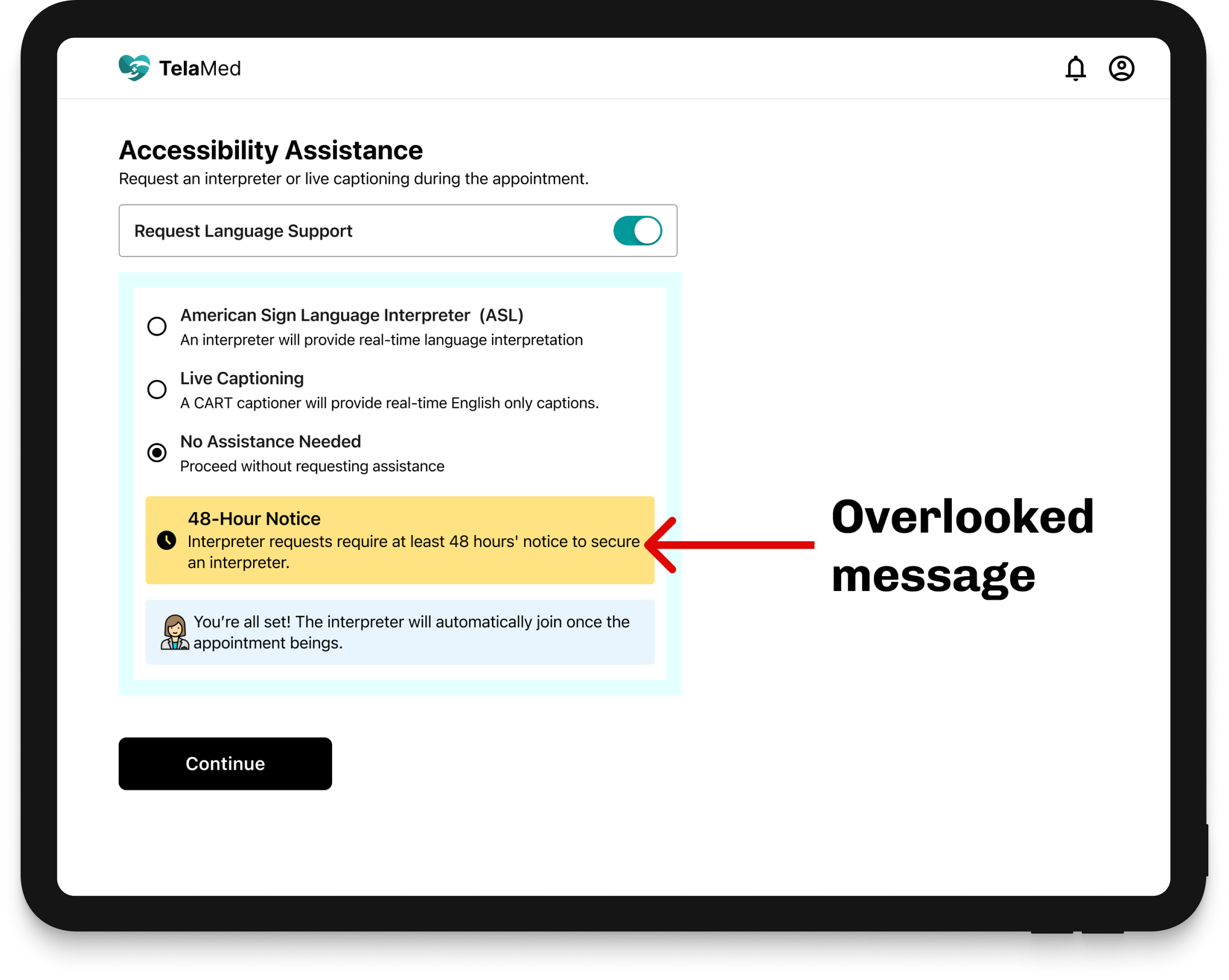
Usability Challenge: Preventing Costly Cancellations
Half of participants overlooked the 48-hour interpreter notice—leading to costly last-minute cancellations.

Solution: A Clear, Unmissable Confirmation Step
Understanding jumped to 87% after launch, significantly reducing last-minute cancellations.
Breaking Barriers: The Measurable Impact

From Inaccessible to Accessible: Immediate Adoption
Before launch, deaf and hard of hearing patients were blocked from telehealth.
Within the first weekend, 10 patients successfully booked accessible appointments—demonstrating this was a critical healthcare fix, not just a feature update.
Proven Visibility: Patients found and used the toggle without assistance, validating its placement on the Confirm Patient screen.

Expanding Beyond ASL: Unlocking a New Patient Population
Beyond ASL: The toggle’s placement unexpectedly addressed another gap—patients with limited English proficiency also began using it to request spoken interpreters.
Business Impact: This insight drove a platform-wide expansion of interpreter support—reaching an even broader patient base.
Fast Execution: From Concept to Critical Accessibility Fix in One Quarte
Slashed development time in half while ensuring full accessibility compliance.
For the first time, deaf and hard of hearing patients had full, independent access to telehealth—without barriers.
